The day after CanvasCon EMEA wrapped up in Oslo, a group of learning technologists and administrators from across Europe, Middle East and Africa, joined us for the second time this year for a focused Customer Discovery Session (CDS).
Where CanvasCon was about sharing what’s new, this day was about listening: understanding real-world workflows, validating our AI-related priorities, and co-designing what comes next for course creation, content quality, and assessment in Canvas.
This session was part of our broader Customer Connectivity Program, where we bring customers into the product discovery process as ongoing partners rather than one-off consultees.
Roadmap, releases, and the human side of change
We started by sharing our current goals and H2 priorities and inviting participants to react. A few messages came through clearly: Predictability is crucial.
- Release communication needs to be audience-aware. Institutions often rewrite release notes for students, educators, and admins.
- Roadmap transparency guides build-vs-buy decisions. Knowing what’s likely to ship helps institutions decide whether to develop tools in-house or wait for native support in Canvas.
That set the tone for the rest of the day: every idea discussed was not just on what it could do, but on how safely and sustainably it could be introduced.
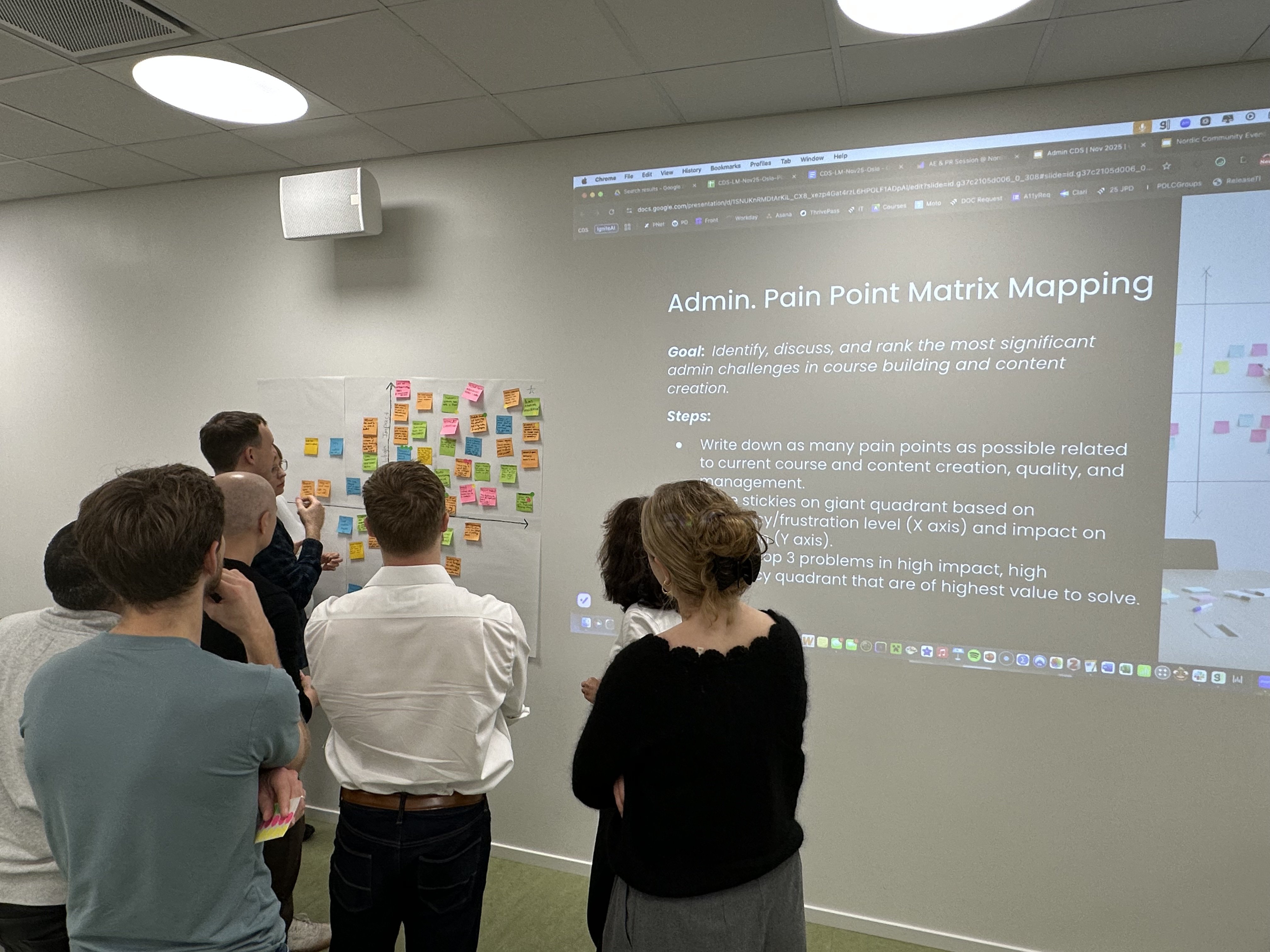
Mapping pain points and rethinking course setup
To focus on what matters most, we ran an administrative pain point mapping exercise. Participants plotted their biggest friction points on an impact vs. frustration matrix across course setup, content reuse, quality assurance, and AI governance.
The “top-right” cluster (high impact, high frustration) centered on:
- Complex, error-prone course rollover processes
- The effort required to clean up outdated content, broken links, and inconsistent design
- The difficulty of coordinating AI-related decisions across multiple roles and policies
From there, we moved into AI-supported course setup and reuse. Through a “Build-a-Course” activity and a rapid prototyping session, participants sketched their ideal flows. Common themes:
- AI should suggest, not silently decide. Course structures and content generated by AI should clearly appear as drafts for educators to review and adapt.
- Guided flows beat one-click magic. Participants imagined a friendly wizard or “Canvas bot” asking a few focused questions (what to copy, what to reset, how to handle dates and announcements) rather than a single, opaque “copy” button.
- Granular control is non-negotiable. Institutions need partial imports, better handling of templates and Blueprint Courses, and smarter defaults so each new term doesn’t start from scratch—or from a messy clone.
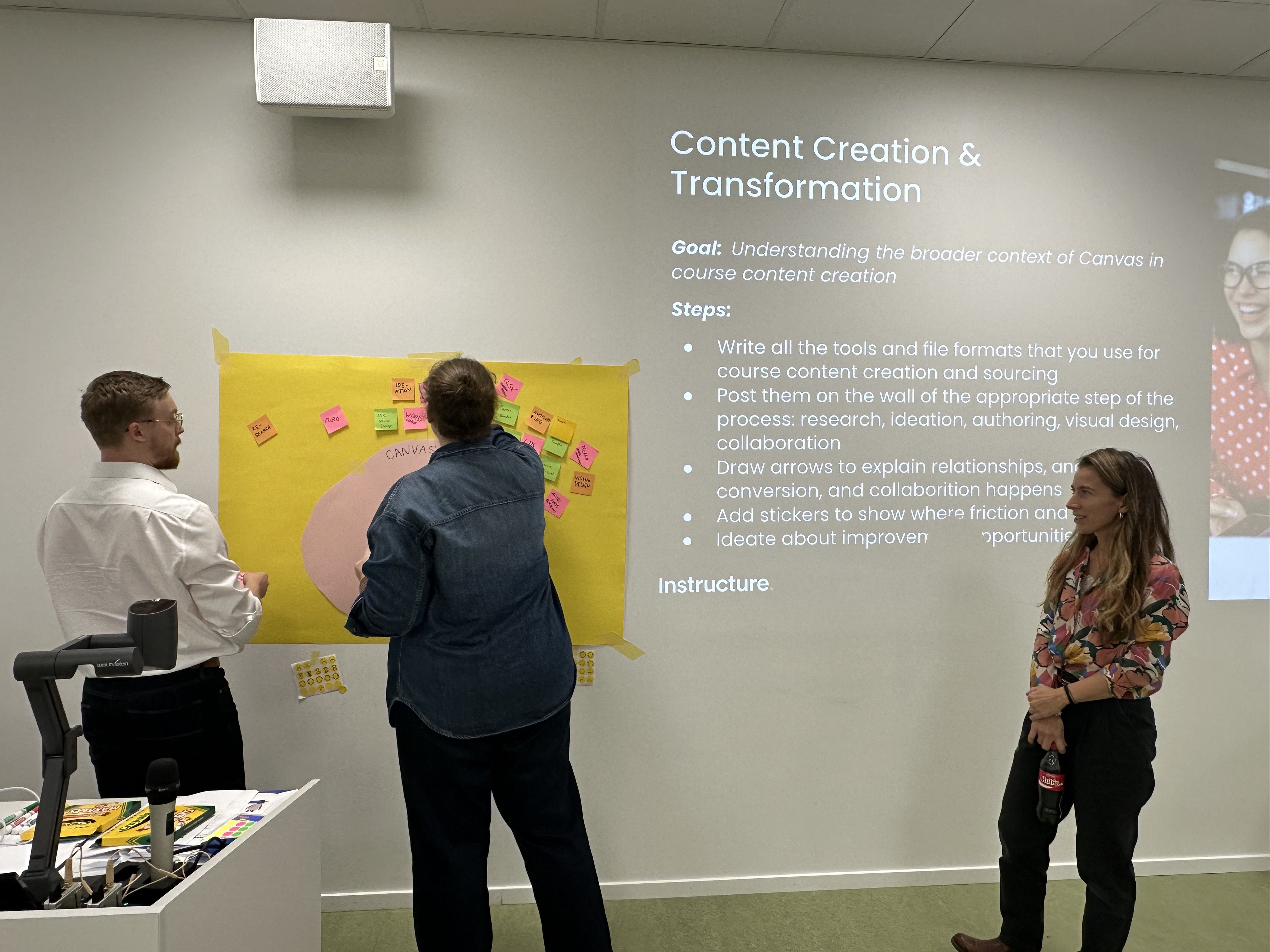
Content creation & transformation: from everywhere into Canvas
In a content journey-mapping workshop, participants covered a wall with the tools and formats used in course creation today: office documents, external interactive tools, whiteboarding platforms, custom systems, LLMs, and more.
A few key insights:
- Content starts in many places, but needs to live in Canvas. Word, PowerPoint, PDFs, and external tools are still common starting points. Getting that content into an accessible, maintainable Canvas format is often manual and time-consuming.
- LLMs are already embedded into institutional workflows. Many staff use tools like ChatGPT and Copilot to generate or refine content before bringing it into Canvas.
- Content transformation is a big opportunity. Automating the conversion of common file types into Canvas Pages or quiz items — then using AI to refine and align them with learning outcomes — would remove a lot of repetitive work.
The overall message: institutions aren’t waiting for AI, but are already using it. Our role is to support those practices safely, with better transformations and guardrails.
Accessibility and dashboards: quality built into everyday work
Accessibility and course quality came through as shared responsibilities that are hard to scale.
After exploring a prototype of a course content accessibility checker, participants designed teacher and admin dashboards using “feature stickers” and a fixed budget. Institutions consistently asked for:
- Smarter prioritization, not just more reporting. Institutions want to see where to start, what will have the biggest impact, and what could be fixed in bulk.
- Role-aware views and permissions. Different people (admins, team leads, student workers) may help with remediation but don’t all need the same level of system access.
- Accessibility checks closer to publishing. Accessibility isn’t a late-stage audit; it’s integrated into content creation and required (or strongly encouraged) before courses go live.
AI-powered learning experiences and governance
We also explored AI-powered learning experiences in Canvas (formerly LLM assignments), with a short demo followed by hands-on scenario design.
Participants were excited about:
- Simulated conversations (for example, patient–nurse, client–consultant, artist–producer) where students can safely practice complex, real-world interactions
- Using AI for formative practice and self-testing, not just summative assessment
- Capturing the learning process, not only the final answer
In a separate AI governance blueprint activity, small groups sketched workflows where multiple human roles review AI-generated outputs, templates stay safely “unbreakable,” and accessibility and policy checks are embedded into the process.
What’s next
The Oslo CDS confirmed that, across very different institutional contexts, many needs are shared:
- Reduce administrative overhead
- Make AI trustworthy, transparent, and pedagogy-first
- Embed accessibility and quality into daily workflows
- Communicate roadmap and releases in ways that help teams plan, not panic
Insights from this session feed directly into our prioritization and upcoming work on course setup and reuse, content creation and transformation, accessibility monitoring, and AI-powered learning experiences—alongside what we’re hearing in other regions.
Thank you to everyone involved in mapping, sketching, challenging, and dreaming with us. We’re excited to keep building these solutions with you!